Pilates for Yoga Teachers

with Vanessa Michielon

Guide your students toward integrated strength, healthy posture and mental clarity


€240.00

PURCHASE NOW

8-hour
online course

Unlimited access for flexible study

Theory

Learn the methodology of Pilates to understand how it develops strength, mobility, coordination and endurance while refining the way we move.

Practice

Learn sets of Pilates exercises and progressive mobility drills for different target areas and specific concerns, with or without props.

Teaching

Learn how to incorporate Pilates into your yoga classes, but also practical tools, precise imagery and anatomical cues to teach Pilates, specifically.


Pilates for Yoga Teachers is a complete training that shows you how to properly integrate Pilates principles into your yoga classes. You will learn the core foundations of the method, from postural alignment and precise movement to deep core connection and functional strength.

You will also explore how Pilates enhances mobility, coordination, endurance and body awareness while supporting lifelong musculoskeletal health, nervous system regulation and mental clarity.
This training will help you guide your students toward integrated strength, healthier posture and a more embodied relationship with movement.

Across six essential modules, you will gain a grounded understanding of Pilates principles and how to integrate them into Yoga classes in a way that is accessible and supportive for all bodies.


You will: 
  • Learn the origins of the Pilates method, the six key principles and how breath, centring and control create a stable base for movement and complement yoga.

  • Understand why functional alignment matters and how to cue it with clarity and precision. Explore neutral spine, neutral pelvis, standing and supine set ups and the essential role of imagery in refining posture. 

  • Learn the anatomy of the 'powerhouse', how to activate deep inner stabilisers and how to cultivate spinal mobility and stability. You will explore exercises for back articulation, back extension and balanced core work that will assist with transitions in yoga.

  • Understand hip mobility, the role of the pelvic floor in hip mobility limitations and the best ways to work on pelvic steadiness with your students. You will practice progressive hip strengthening and mobility patterns that support lunges, standing poses and backbends.

  • Study the structure of the shoulder girdle, the balance between mobility and stability and how to prepare students for weight bearing. You will focus on targeted pulling patterns and resistance band work, which complement yoga that mainly focuses on pushing.

  • Explore the foundation of movement through the tripod of the foot, ankle mobility and functional standing patterns. Proper foot engagement influences the whole kinetic chain from knees to hips to spine and foot work can greatly support ease of movement at any age.


Course outline

Module 1: Foundations of Pilates

Welcome to this specialised programme designed for Yoga teachers who wish to expand their embodiment skills and refine the way they support their students through Pilates. In the following modules, you will be introduced to how Pilates principles and practices can complement Yoga Asana, offering greater awareness, stability and ease in movement.

You will learn about the foundations of Pilates as a system centred on postural alignment, precise and efficient movement and a deep connection to the core that improves functional strength.

You will also explore how Pilates develops strength, mobility, coordination and endurance while refining the way we move. At its core, the method trains our ability to recruit our muscles effectively, improve our alignment and enhance our body awareness, qualities that beautifully complement our Yoga practice.

Pilates supports musculoskeletal health throughout life, improving balance, proprioception and controlled mobility, which are essential for joint longevity and easeful movement, so it can benefit people of all backgrounds and abilities. Beyond its physical value, Pilates plays an important role in regulating our nervous system through a mindful connection with the breath and improving our concentration, clarity and overall mental wellbeing.

By understanding the holistic benefits of this method, you will gain deeper insight into how and why it can improve both your personal practice and your teaching. This knowledge will support you in guiding your students toward integrated strength, healthier posture and a more embodied relationship with movement at any age.

 

In this session, we take a look at the origins of Pilates and how the method has evolved into one of the most respected and versatile movement systems used today. You will be introduced to the life and legacy of Joseph Pilates, who transformed his own physical challenges into a revolutionary approach to strengthening, healing and balancing the body.

We will explore how Pilates emerged from a blend of anatomy study, athletic training and influences from both Eastern and Western movement traditions. You will learn how his method, originally called Contrology, was shaped by practical rehabilitation work, particularly during the First World War, and later recognised by leading dance pioneers and choreographers in the US for its powerful effect on performance optimisation and injury prevention.

You will also discover that different branches of Pilates exist today, from classical lineages that preserve Joseph’s original repertoire to more contemporary adaptations used by physiotherapists, athletes and teachers supporting specific populations. Despite these variations, the primary intention remains the same: to improve our functional alignment, enhance neuromuscular control and create a strong and balanced body.


.

This session introduces you to the six key principles that shape every Pilates exercise and define the essence of the method: breathing, concentration, centring, control, precision and flow. Rather than focusing on how many repetitions we do, Pilates invites us to move with attention, accuracy and intention, transforming simple exercises into deeply intelligent work.

You will discover how these principles influence both the physical experience of movement and our mental presence. We will explore how breathing supports core activation, how centring builds stability and integrated strength, and how precision helps us avoid compensation patterns and cultivate better alignment. You will also learn how control and flow work together to create movement that is efficient, smooth and purposeful.

As Yoga teachers, understanding these principles will give you fresh tools to help your students move with refined awareness, developing strength and stability without unnecessary tension.

In Pilates, breathing is an integral part of movement. It influences how we organise the body, stabilise the spine, and maintain clarity and focus throughout the practice. Pilates applies this knowledge very intentionally, using the breath not only for mindfulness but also to support the recruitment of the core muscles and to maintain a set rhythm within the same exercise.

A key feature of the method is lateral or thoracic breathing. Instead of allowing the abdomen to expand forward, like we do often in Yoga with diaphragmatic breathing, the ribcage widens to the sides and back, while the deep abdominal muscles stay gently engaged. This helps us stabilise the trunk, so our limbs can move freely and efficiently.

Breath is also coordinated with the phases of movement: generally, we inhale to prepare and exhale during the effort. This prevents breath-holding and enhances the activation of our deep core muscles.

One of the greatest gifts Pilates brings us as Yoga practitioners and teachers is a deeper sense of control, alignment and confidence in movement. Through slow and precise patterns, we learn how to organise our body from the centre, strengthen what supports us and move with greater integrity and ease. These qualities translate directly into our Yoga practice, especially when it comes to balancing, transitioning and supporting our joints over time.

In this session, we will explore some of the ways Pilates can complement our Asana practice and some options for including Pilates exercises in our Yoga sequences.

In this session, we focus on key teaching considerations for Pilates, helping you guide your students safely and effectively. We explore how to honour individual bodies, adjust the intensity with gradual progression and recognise when it is best to pause or reset an exercise.

In this practice, we explore lateral thoracic breathing from different positions as a way to direct the breath laterally into the sides and the back of the ribcage, creating space while maintaining spinal and core stability.

Please have a long elastic band ready if you wish to experiment with the same pattern using extra tactile feedback.

Warrior I is a powerful standing pose that offers many benefits when practiced with awareness. Using a strap helps lengthen the spine and open the front body while encouraging grounding through the back foot for stability and a strong, balanced foundation.

Module 2: Posture and alignment

In this session, we explore the concept of posture and the neutral spine, the foundation for most Pilates exercises. You will learn how our muscles and nervous system continuously adjust our alignment and why understanding and finding a neutral posture allows for optimal support of the spine, joints and limbs. We will discuss how maintaining the natural curves of the spine minimises stress, improves breathing and provides a balanced base for movement.

We will also acknowledge that the amount of curvature in the spine is individual, that variability exists from person to person and that it is not necessarily associated with pain.

Still, we can use the neutral spine and the neutral or anatomical posture as reference points to give ourselves and our students possibilities, to question our habits, to unlock different options to move and rest and to possibly find more comfortable and effective ways of holding ourselves.

In this session, we explore the principles of neutral standing alignment and the positioning of the pelvis. You will learn how to identify key bony landmarks and visualise the body in balance along an imaginary vertical line, the plumb line, creating stability with minimal muscular effort. We will focus on recognising a neutral pelvis and understanding its relationship to the spinal curves, while appreciating the natural variations in individual anatomy.

In this session, we explore the supine position and the concepts of neutral versus imprinted spine.

You will learn how to guide your students into a safe and supportive supine set up, paying attention to alignment, spinal curves and pelvis positioning.

We will also examine when a neutral spine is most effective and when an imprinted position can reduce strain, especially for students with lower back sensitivity or hyper lordosis. 

In this session, we explore the power of imagery to support posture and alignment in Pilates. You will learn how to guide your students to lengthen the spine from coccyx to crown, imagine the pelvis weighted like an anchor and the head floating lightly like a buoy.

We will use visual cues such as scooping the spine like ice cream and moving the vertebrae one by one like a string of pearls.

These images can help your students cultivate precise spinal articulation, stabilise the pelvis and maintain a more easeful and integrated posture.

In this session, we explore why alignment of the spine matters in Pilates and how the concept of a neutral spine can guide our teaching. We will discuss why there is no single perfect posture and how spinal alignment is unique to each individual, influenced by anatomy, habits and lifestyle. You will learn to use neutral spine as a reference point rather than a fixed ideal, helping your students develop awareness, control and adaptability.

This approach emphasises functional movement, dynamic spinal control and mindful engagement over rigid adherence to a single shape, allowing for a safer, more effective and personalised practice.

In this session, we explore the foundations of Pilates alignment through both standing and supine set ups, focusing on key anatomical landmarks and how to find a neutral spine.

We will also experiment with spinal mobility, moving between imprinted and neutral positions and exploring C shaped curves, pelvic tilts and chest lifts.

Module 3: Core and spine

In this session, we introduce the concept of the core, or powerhouse, and its role in Pilates. Adopting one of the existing models to define our core, you will learn to differentiate between the inner stabilisers, including the transverse abdominis, multifidus, diaphragm and pelvic floor, and the more superficial muscles of the outer core that generate movement.

We will examine how the core functions to stabilise the trunk, transfer force between the upper and lower body and support efficient and controlled movement. This session provides a foundation for understanding how to engage and cue the core safely in our teaching practice.

In this session, we focus on core stability as a form of neuromuscular control and discuss its role both in Pilates and Yoga.
You will explore how the deep core muscles maintain spinal alignment, provide support during movement and prevent compensations such as unwanted arching or tilting in the spine.

We will look at how stability and mobility work together, allowing the body to move efficiently while minimising excessive stress on our joints and enhancing control.

In this session, we explore spinal mobility and articulation, how the spine can move freely, smoothly and safely across all its natural ranges, including bending forward, arching back, twisting and side bending.

You will see how Pilates gives us many opportunities to practice controlled, segmental movement of the spine, developing strength, flexibility and neuromuscular coordination.

In this session, we focus specifically on spinal extension, or back extension work. You will learn how to move and hold your spine safely and efficiently, articulating segment by segment while maintaining core support. We will also focus on how to co-contract the abdominals and back muscles to create length and spaciousness in the spine, rather than collapsing while back bending.

This practice offers you practical tools to use imagery and anatomical cues to guide your students through pelvic floor activation and relaxation in synchronicity with the breath.

In this practice, we explore Pilates based core stability exercises, including the use of bricks for support and challenge.
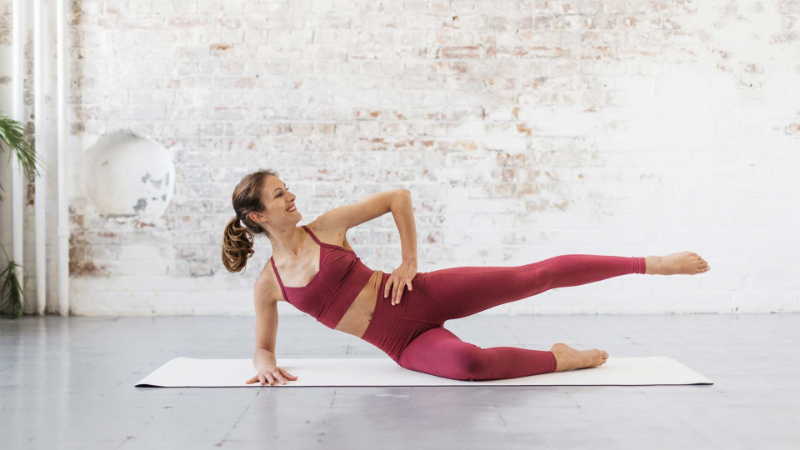
You will practice seated, supine, side lying, prone and standing exercises like side planks, Single Leg Circle, Toe Taps and Swimming preparation, designed to enhance spinal stability, pelvic control and coordinated movement.

Emphasis will be on maintaining a strong, stable centre while allowing the limbs to move freely, helping you and your students build strength, control and body awareness.

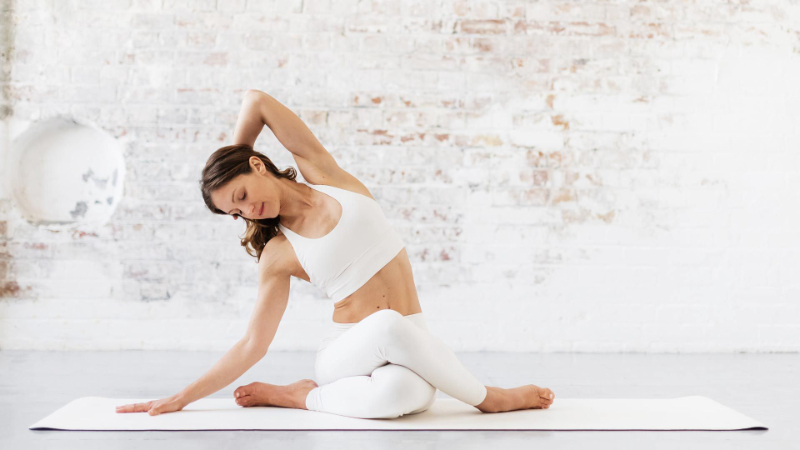
In this practice, we focus on spinal articulation and mobility, moving vertebra by vertebra to prepare the body for deeper and more effortless backbends, twists and curls in Yoga. Through guided visualisations and progressive mobility drills, we will explore smooth, connected movement like the Roll Up, Spine Twist, Spine Stretch and Mermaid, with possible variations to suit different bodies and increase or decrease the level of challenge.

In this practice, we focus on strengthening the back of the body, the entire posterior chain, to support safe and sustainable backbends in Yoga. Rather than aiming for a deep spine extension, we prioritise length, spinal integrity and balanced activation of the muscles in the core area.

You will learn how to lift into extension sequentially, beginning with the upper spine, and how to co activate the deep abdominals so the lower back feels supported rather than overly compressed.

Module 4: Hips

In this session, we explore hip mobility through the lens of Pilates, where movement at the hips and stability at the pelvis are connected.

Hip mobility is the ability of the head of the femur to move smoothly in the hip socket in all directions with strength, control and integration from the core.

The hip is a ball and socket joint designed for a wide range of motion:

  •  Flexion: lifting the leg forward, supported by the quadriceps, ileopsoas, sartorius and tensor fasciae latae
  • Extension: moving the leg back, primarily powered by gluteus maximus and the hamstrings
  • Abduction: lifting the leg out to the side, involving gluteus medius, gluteus minimus and tensor fasciae latae
  • Adduction: bringing the leg toward the midline, supported by the inner thigh muscles which also stabilise the pelvis
  • External rotation: turning the thigh outward with the deep rotators beneath the glutes
  • Internal rotation: turning the thigh inward with the same muscles that create abduction.

These actions allow us to walk, bend and twist. In our Yoga practice, mobility at the level of the hips supports balanced load distribution during standing postures, warriors and lunges.

Because every hip joint has slightly different bony architecture, each person’s available range will look different.

In this session, we explore how true hip mobility is supported by pelvic stability. When the pelvis remains steady and only the thighbone moves in the hip socket, the movement comes from the hip joint itself rather than compensating through the lumbar spine or the knees.

Pelvic stability relies on the coordinated support of the deep core and the hip stabilisers, allowing the pelvis, sacrum and lumbar spine to stay aligned under load. This is what Pilates calls lumbopelvic stability, an essential expression of the powerhouse.

Hip mobility and pelvic stability work together: a stable pelvis gives the hips space to move, and mobile hips prevent unnecessary compensation in the spine.

In this practice, we use a series of bridging variations to strengthen the muscles that support healthy backbends, especially gluteus maximus, the hamstrings and the deep stabilisers of the pelvis and lower back.

In this practice, we activate our glutes using resistance bands and bodyweight work to support a stronger Yoga practice.

We will move supine, side lying, prone and on all fours, targeting the hips from different directions with exercises like Side Kicks, Clamshells with a loopy band and quadruped leg lifts, all with a focus on keeping the pelvis steady as the leg moves.

In this practice, we focus on pelvic stability, the ability to keep the pelvis steady while the legs move freely. These drills are highly practical for anyone interested in refining control, but especially valuable for hyper mobile practitioners or those returning to the practice after a hip injury, who can benefit from learning how to create strength within their range.

Module 5: Shoulders

Now we turn our attention to the shoulder girdle.
Many of the challenges we encounter in Yoga, whether we are lifting our arms overhead, bearing weight through the hands or transitioning between postures like Downward Dog, Plank, Side Plank or arm balances, often come from limited mobility or insufficient stability around the shoulders.

The shoulder complex is not just one joint but a coordinated system that includes the glenohumeral joint, the scapula on the rib cage and the joints connecting the scapula and clavicle to the rest of the skeleton. This design gives us an incredible range of motion, allowing us to position the hand in space with great freedom, but it also requires strong neuromuscular support to maintain control.

In this session, we look at how the humerus moves at the glenohumeral joint through flexion, extension, abduction, adduction, rotation, horizontal abduction and adduction and full circumduction, and how the scapula contributes through elevation and depression, protraction and retraction, upward and downward rotation and subtle anterior and posterior tilting.

We will also bring awareness to the relationship between the arm and the shoulder blade, the scapulohumeral rhythm, which supports smooth, integrated movement and more sustainable load bearing in our practice.

The shoulder is a uniquely mobile joint, capable of extraordinary ranges of motion, but its design prioritises movement over bony stability. Unlike our deeply socketed hip, the shoulder relies almost entirely on muscles, tendons and ligaments to keep the humeral head centred in the shallow glenoid fossa.

A key principle you will explore in this session is how to balance mobility with stability. When we move our arms upwards, we want to make sure our scapulae are neither collapsed toward the ears nor rigidly depressed, but supported in a neutral, functional position.

In this session, we explore how we can create balanced strength for the shoulders by targeting movements in all directions, both pushing and pulling.
In Yoga, pushing movements dominate, whether pressing away from the floor or extending out of poses. Pulling, on the other hand, is often underdeveloped, as in any bodyweight only practice. Pilates band work offers a valuable opportunity to engage these often neglected patterns, directly targeting muscles like latissimus dorsi, the rhomboids and the rotator cuff.

By using resistance bands, we can also improve our proprioception, the nervous system’s ability to sense joint position. The dynamic resistance of the band challenges our stabilising muscles in the shoulder girdle and trunk to adapt continuously and avoid jerky movements.

In this practice, we focus on developing balanced upper body strength and scapular stability using pulling exercises with resistance bands.

Both seated and standing exercises will target pulling in multiple planes, from triceps and biceps work to overhead and side pulls and rows. We will finish with two classical Pilates exercises, the Side Bend and the Roll Over, to put our shoulder stability and mobility activations into practice.

In this short practice, we focus on activating the serratus anterior and the rotator cuff muscles, key stabilisers that prepare us for more integrated Plank poses and arm balances.

We will use both bodyweight and resistance bands to isolate and strengthen these areas. Movements will include arm rotations and serratus dips in different positions, all designed to enhance awareness and coordination around the scapula, rib cage and humeral head.

Module 6: Feet and ankles

Our feet are intelligent, sensory structures that set the tone for alignment, balance and movement throughout the body. When our feet are weak or inactive, the knees, hips and spine often compensate, sometimes leading to inefficiency in force transmission, tension or discomfort.

In this session, we will focus on exploring ankle movements like dorsiflexion, plantar flexion, pronation and supination.
We will also introduce the concept of distributing our weight evenly through the tripod of the foot, the ball of the big toe, the outer edge of the little toe and the centre of the heel, to create stability and support the activation of the deep core stabilisers.

In this practice, we bring awareness and strength to our feet and ankles using a long resistance band. These exercises are designed to activate the intrinsic foot muscles, improve ankle mobility and engage the lower leg stabilisers.

We start with seated ankle rolls and progress to coordinated foot movement and abdominal exercises like bicycles and frog presses. Bridges with heel raises and plank variations with rocking will further integrate ankle control with core activation.

In this ten minute practice, we focus on building foot and ankle strength, stability and mobility from a standing position.

We will explore pronation and supination, heel raises, squats, lunges and dynamic standing exercises that challenge our balance, such as slow transitions from leg lift with a twist into Warrior III.

I hope you have enjoyed the journey and are leaving with not only a deeper appreciation for Pilates but also a clearer sense of how it can enrich your Yoga teaching.
Pilates provides a language of movement that sharpens our understanding of biomechanics, how the spine articulates, how the pelvis stabilises to support hip mobility, how the shoulders move with integrity and how our breath supports it all.

The six Pilates principles, concentration, control, centring, precision, breath and flow, naturally align with cultivating focused awareness in Yoga.
I encourage you to use them to help your students balance mobility and stability, strengthen under active muscles and bring intelligence and body awareness to every transition and pose.

Thank you for being part of this journey!

Meet your teacher:

Vanessa Michielon


Vanessa is a yoga and Pilates teacher, empowering people of all walks of life to embrace yoga, Pilates and dance in order to improve physical health and achieve a balanced state of mind.

Also a yoga and dance lecturer in Higher Education, Vanessa has has been teaching for over 14 years, including for some of London’s top studios and UK Festivals.

Some of her specialisations include Yoga Therapy for Anxiety, Advanced Yoga Psychology, Applied Polyvagal Theory in Therapeutic Yoga for Trauma Recovery, L3 Pilates, Pre and Postnatal coaching and Contemporary Dance.

Vanessa believes that embodied movement can radically transform our life and wishes to help others find joy and purpose in their practice.

You can  download her free ebook Release your body, Ease your mind – a step-by-step guide to stress relief through movement and breath at www.vanessamichielon.com.


PURCHASE NOW